
You walk through the door, your dog looks up, gets to their feet, stretches their front legs forward, lifts their back end into the air — and then comes straight over to greet you.
It is one of those small dog behaviours that can feel surprisingly personal.
But why do dogs stretch when they see you?
The answer is usually a combination of physical movement, relaxation, anticipation, and learned behaviour. And while people sometimes call it an “I love you stretch,” the meaning is a little more nuanced than that.
Why Does My Dog Stretch When They See Me?
One of the simplest explanations is that your dog was resting before you appeared.
Dogs often stretch after getting up in exactly the same way humans do. The movement helps loosen the body after lying down and prepares the muscles for activity.
But greetings can add another layer.
A dog may stretch because seeing you signals that something is about to happen — attention, interaction, a walk, food, or simply a change from resting to being active.
Veterinary behaviourists also note that greeting stretches can appear when dogs are relaxed and comfortable around the person approaching them. PetMD explains several reasons dogs stretch during greetings.
Is Stretching a Sign That Your Dog Is Happy to See You?
It can be.
If the stretch happens as part of a relaxed greeting — with a loose body, soft expression, relaxed ears, and enthusiastic approach — it may be part of your dog's positive response to seeing you.
But stretching should not automatically be translated as “my dog is telling me they love me.”
Dogs communicate through combinations of posture, movement, facial expression, sound, scent, and context. Researchers studying canine communication have long emphasised that body language has meaning as part of a wider social interaction rather than as isolated movements. Research on canine communication
So it is better to look at the whole dog.
A relaxed stretch followed by a wagging tail and an approach for attention tells you much more than the stretch alone.
Why Is It Sometimes Called the “I Love You Stretch”?
The phrase has become popular because many owners notice that their dogs perform a particular deep stretch during affectionate greetings.
Usually, the dog extends the front legs forward, lowers the chest, and keeps the back end raised.
It can look very deliberate.
Because it often happens when a familiar person returns home or approaches the dog, it is easy to interpret it as a direct declaration of affection.
In reality, several things may be happening at once.
Your dog may have just woken up, may feel relaxed around you, may anticipate interaction, and may have learned that stretching gets a warm response from you.
The emotional connection can be part of the moment without the stretch having one universal translation.
Dogs Can Learn That You Love the Behaviour
Dogs are remarkably good at noticing which behaviours get a reaction.
Imagine your dog stretches every time you arrive home.
You smile, bend down, speak affectionately, stroke them, and tell them how adorable they are.
From your dog's perspective, that behaviour just worked extremely well.
Over time, a dog may become more likely to repeat behaviours that reliably lead to attention or interaction.
That does not make the greeting less genuine.
It simply shows how closely dogs learn the little routines they share with us.
Is a Greeting Stretch the Same as a Play Bow?
They can look similar, but they are not always the same thing.
During a classic play bow, a dog lowers the front of the body while keeping the back end raised, often with more energetic and exaggerated body language.
The dog may bounce away afterwards, wag enthusiastically, run in a circle, or clearly invite another dog or person to play.
A stretch after resting is often slower and more sustained.
Context makes the difference.
If your dog stretches and then immediately brings you a toy or darts across the room, play may be exactly what they had in mind.
If they stretch slowly, walk toward you, and settle nearby, the movement was probably simply part of waking up and greeting you.
Why Does My Dog Stretch Before Coming Over to Me?
Dogs are constantly moving between rest and activity.
If your dog has been sleeping on their bed while you work in another room, hearing your footsteps may be enough to wake them.
They stretch.
They get up.
And then they come to see what you are doing.
Because these steps happen within seconds, it can look as though the stretch itself is specifically directed at you.
Sometimes it may be part of the social greeting. Sometimes you simply happened to arrive at exactly the moment your dog was getting up.
Both can be true.
What Does a Relaxed Dog Stretch Look Like?
A comfortable stretch usually appears fluid rather than stiff.
The dog's body looks loose. Their expression is soft. They may blink, yawn, shake their body afterwards, or casually walk toward you.
This is very different from repeatedly stretching while appearing uncomfortable.
Context matters particularly when the behaviour suddenly changes.
If a dog begins stretching unusually often, seems unable to settle, repeatedly takes a stretched position without relaxing afterwards, or shows other signs such as reduced appetite, vomiting, trembling, or sensitivity around the abdomen, it is worth speaking with a veterinarian.
A normal greeting stretch should look comfortable.
Why Small Greeting Rituals Matter
Dogs build surprisingly detailed routines around the people they live with.
Some bring a toy when their owner comes home.
Some spin in circles.
Some stretch.
Some simply walk over and lean against a leg.
These small rituals are part of the daily communication that develops between dogs and humans.
And because every dog has their own habits, the behaviour can eventually feel almost like a private language between the two of you.
Dogs are constantly moving between rest and activity.
If your dog has been sleeping in a comfortable spot while you work in another room, hearing your footsteps may be enough to wake them.
They stretch.
They get up.
And then they come to see what you are doing.
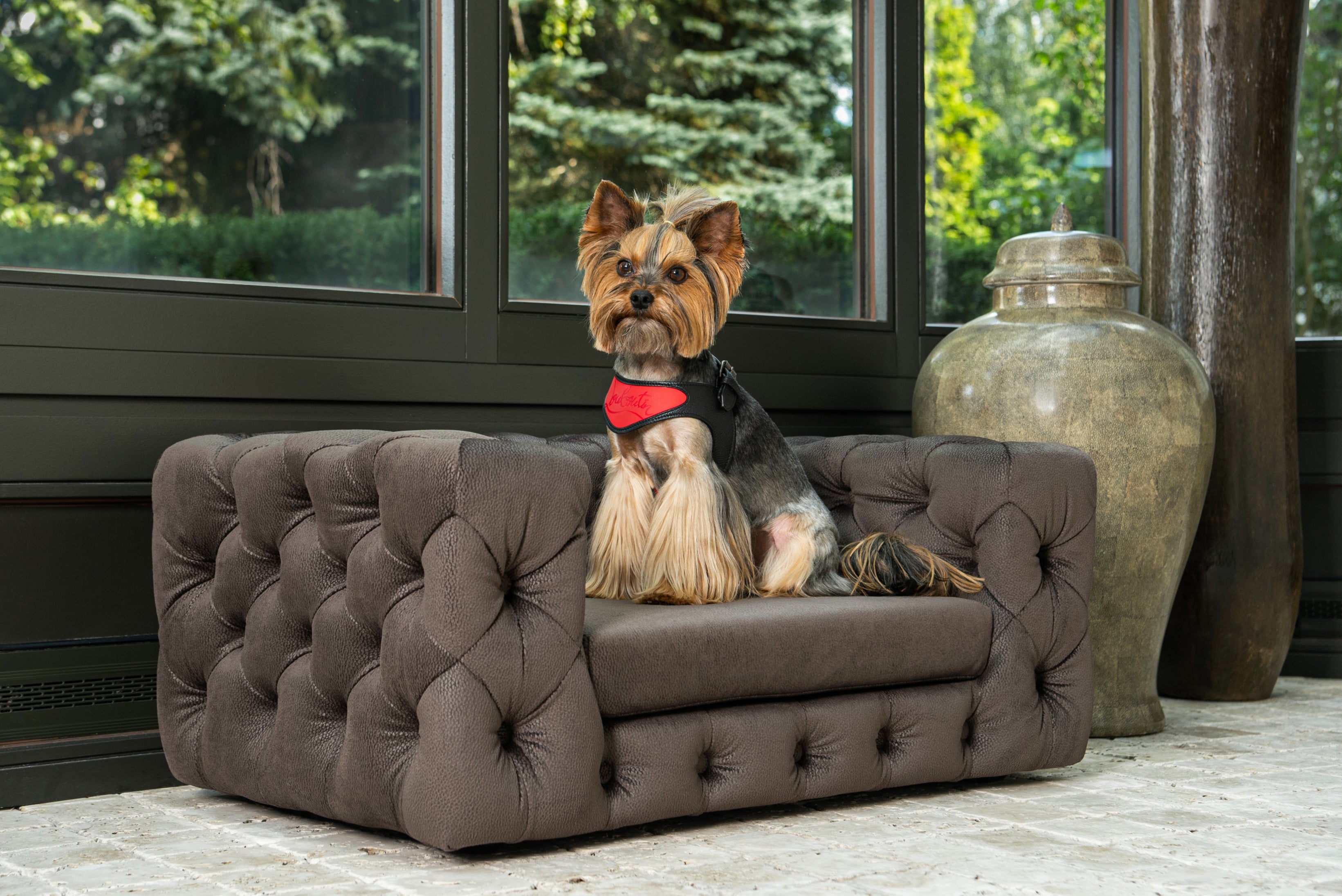
This is why a comfortable resting place matters too. Dogs often choose somewhere they can fully relax while still staying close to the rhythm of the household — whether that is a favourite cushion, a quiet corner, or a comfortable dog sofa in the living room.
Because these steps happen within seconds, it can look as though the stretch itself is specifically directed at you.
Sometimes it may be part of the social greeting. Sometimes you simply happened to arrive at exactly the moment your dog was getting up.
Both can be true.